

By Graeme Salt
With home prices falling and the prospect of another interest rate rise still hanging over the market, it raises a question: is the housing market simply correcting after several years of strong growth, or are we heading towards something more severe?
National home prices have declined for five consecutive months, falling 2.7 per cent from their March 2026 peak. And more is likely to come
The downturn is more advanced in some of the major capital cities. Sydney home prices are now 4.9 per cent below their November 2025 peak, while Melbourne prices have fallen 5.3 per cent since October. Brisbane, which remained resilient for longer, has fallen 2.8 per cent in just five months.
But looking back through more than four decades of home price data provides some useful perspective.
The current downturn has been unusually fast, but, so far, not been unusually deep. If the recent pace of price falls continued, however, it could eventually become the largest national peak to trough decline in at least four decades.
Even then, conditions that typically turn a housing market correction into something much more serious are largely absent at present.
The biggest risk would be if today’s conditions were joined by a significant labour market shock. And here there are concerns as the Reserve Bank believe unemployment needs to rise so that inflation can be tamed.
Housing downturns are relatively uncommon in Australia
One of the most striking features of Australia’s housing market is how infrequently national home prices experience sustained nominal declines.
Looking back to 1980, there have been 14 previous periods in which national prices have fallen below a previous peak before recovering.
Many of those were barely downturns at all, with prices falling by less than 1 per cent.
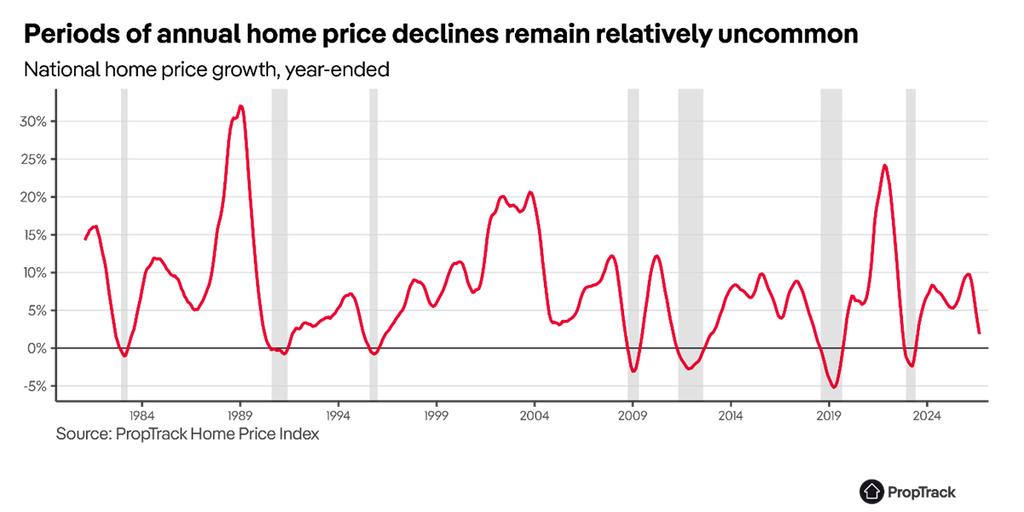
Only seven previous national downturns produced peak to trough declines greater than 1 per cent and were always less than 6 per cent.
The larger corrections have generally been concentrated around periods of significant economic or financial adjustment.
National prices fell 3.5 per cent during the Global Financial Crisis in 2008, 3.1 per cent between 2010 and 2011, 5.3 per cent during the credit tightening led downturn of 2018-19 and 3.6 per cent during the rapid interest rate tightening cycle in 2022.
The current 2.7 per cent decline therefore isn’t exceptional in size. What stands out is how quickly it has happened.
The current downturn has been unusually swift
National prices peaked in March and are now 2.7 per cent lower just five months later. That is already a larger decline than occurred across the entirety of the national housing corrections of the early 1980s, 1990 and 1994-95.
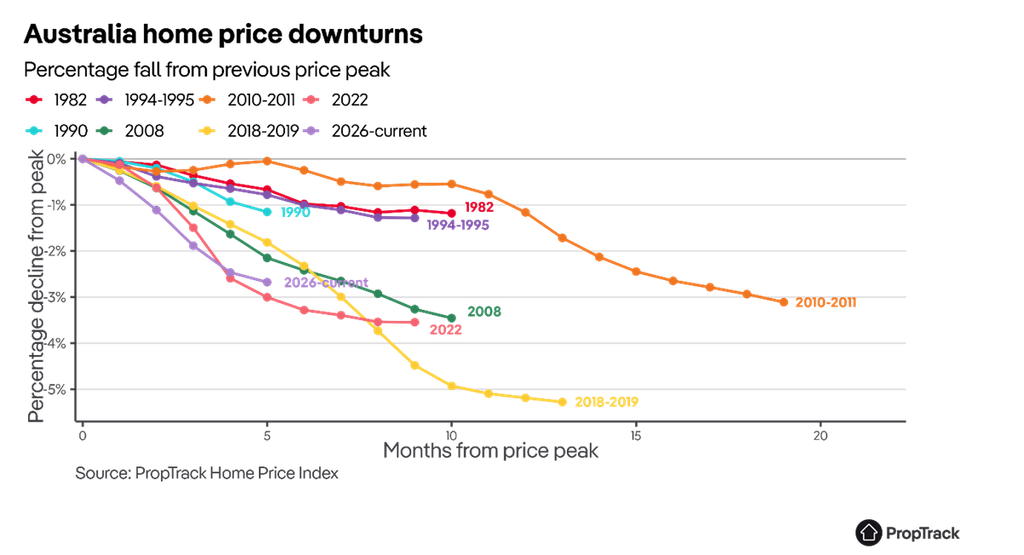
Measured as the average decline from peak per month, the current adjustment has also been faster than the major completed national downturns of 2008, 2010-11, 2018-19 and 2022.
But a more useful approach is to compare prices at the same point after each market peak. On that measure, the 2022 downturn remains marginally sharper. Five months after the 2022 peak, national home prices were 3.0 per cent lower. Five months into the current downturn, prices are down 2.7 per cent.
In 2022, price falls accelerated substantially as successive interest rate rises rapidly reduced borrowing capacities, before tight supply saw home prices quickly rebound.
This time, the decline has become less pronounced in the latest month, though the downturn remains underway and the spring selling season will be an important test of how this current downturn unfolds into year end.
Another interest rate rise expected before year end will also add to downward pressure on prices.
From May to August, national home prices fell by around 1.6 per cent, equivalent to an average compound decline of roughly 0.5 per cent per month. If that pace continued, national prices would be around 4.7 per cent below their March peak by December 2026 and around 6.2 per cent lower by March 2027, 12 months after the downturn began.
That would surpass the 2018–19 downturn and make the current episode the largest national peak to trough decline in at least four decades.
Sydney and Melbourne are further into the adjustment
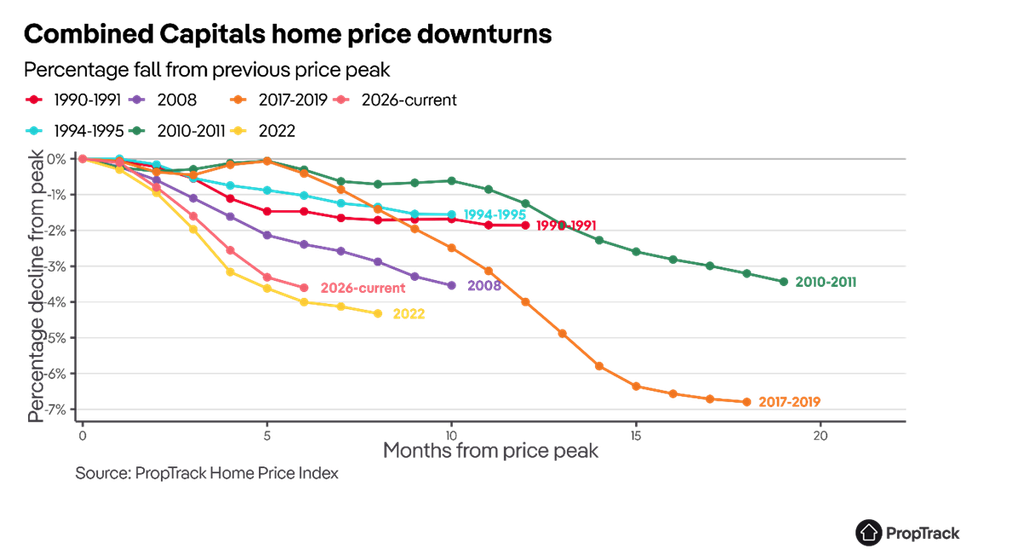
The national figures also conceal significant differences between markets. Sydney and Melbourne entered the downturn well before the national market.
Sydney home prices peaked in November 2025 and have since fallen 4.9 per cent.
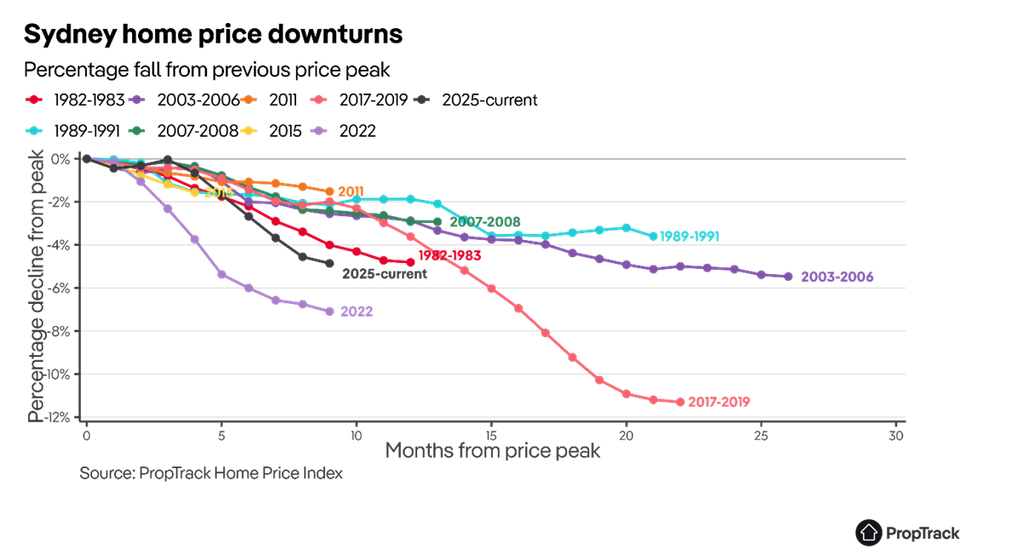
That makes the current downturn one of Sydney’s sharper historical adjustments. At nine months after the peak, only the 2022 downturn had produced a larger decline, when Sydney prices had fallen 7.1 per cent.
But Sydney has also experienced considerably deeper downturns. Prices fell 11.3 per cent between 2017 and 2019, while the 2022 correction ultimately resulted in a 7.1 per cent decline.
Melbourne’s adjustment has been even larger.
Prices are 5.3 per cent below their October 2025 peak. The current Melbourne downturn has already surpassed the city’s entire 4.6 per cent decline during 2022 and the fall experienced during the Global Financial Crisis.
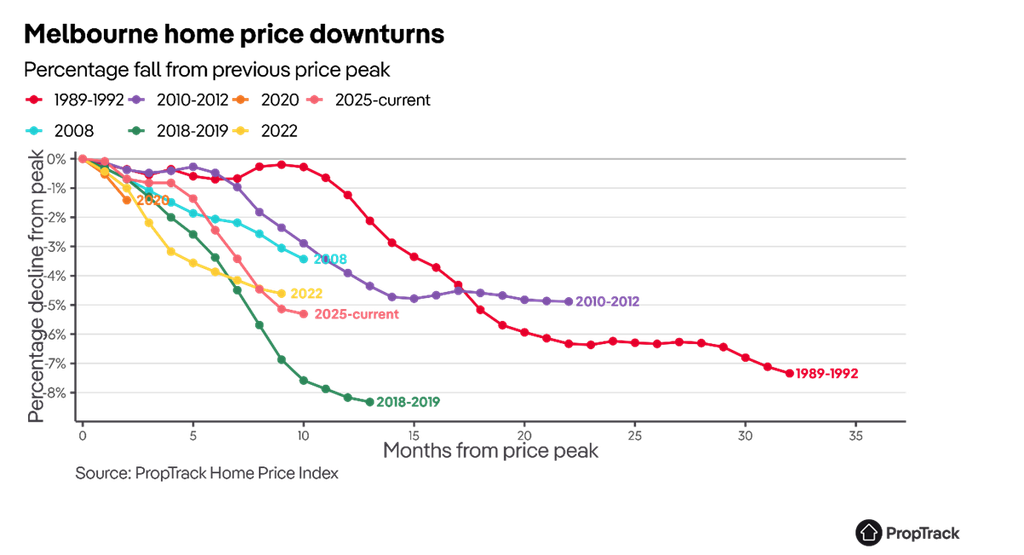
Again, though, history illustrates the difference between the speed and ultimate depth of a downturn.
Melbourne’s early 1990s correction eventually resulted in prices falling more than 7 per cent, but unfolded over 32 months. The current 5.3 per cent decline has occurred in just 10.
Brisbane’s downturn is younger but also historically fast. Prices have fallen 2.8 per cent in five months, already exceeding the entirety of Brisbane’s 2018–19 correction. At the same five-month point, 2022 was slightly sharper, with Brisbane prices down 3.2 per cent.
Why are prices falling so quickly?
Interest rates are an important part of the story. The Reserve Bank has increased the cash rate by 75 basis points this year, taking it to 4.35 per cent.
Higher mortgage interest rates reduce the amount buyers can borrow. A buyer may still want to purchase the same home, but if less money is lent, their capacity to bid is lower.
When that occurs across prospective buyers simultaneously, purchasing power shifts lower and that is increasingly being reflected in home prices.
Higher repayments also affect confidence and household budgets.
Prospective buyers face not only lower borrowing capacities but uncertainty around where mortgage rates will ultimately peak. And that uncertainty has increased with the expectation of another interest rate rise this month or November.
Tax changes are an additional headwind
Changes to negative gearing and capital gains tax announced in the May federal budget have added another headwind.
Investor search activity on realestate.com.au has fallen materially since the budget and investor lending has also begun to pull back.
Interest rates affect both owner-occupiers and investors and are likely the dominant constraint on housing demand. But fewer investors competing for properties alongside weaker owner-occupier borrowing capacity adds to downward pressure.
The confidence channel matters too, uncertainty around whether interest rates rise again, ongoing price falls and the taxation shake up could be driving some buyers to delay purchasing decisions.
It remains too early to attribute a specific proportion of recent price falls to the reforms.
So, is Australia experiencing a housing crash?
The evidence at present says no.
A housing correction can occur when affordability deteriorates, credit becomes more expensive or buyer demand weakens.
A housing crash is usually associated with something more destabilising, rapidly rising unemployment, widespread mortgage distress and forced selling, impaired credit availability, a banking crisis, substantial oversupply, or some combination of these forces.
Those dynamics can become self reinforcing. Job losses create mortgage distress. Distressed owners are forced to sell. Additional supply pushes prices lower and deteriorating balance sheets can further constrain credit and demand.
That is not what Australia’s housing market currently looks like.
The labour market has softened but remains relatively resilient. Mortgage arrears have increased from very low levels but there is little evidence of widespread forced selling
And, Australia continues to have a structural shortage of housing relative to population growth. That does not prevent home prices from falling. But constrained supply can limit the eventual extent of price declines.
What about negative equity?
Another important lesson from previous cycles is that downturns should be considered in the context of what came before them.
Even after recent declines, home prices in many parts of the country remain substantially above where they were several years ago. That matters when interpreting a correction.
A deeper downturn raises concerns about negative equity – when the outstanding mortgage exceeds the market value of the property securing it.
Recent buyers with very small deposits more exposed to falling prices than a homeowner who bought several years earlier and has accumulated significant equity.
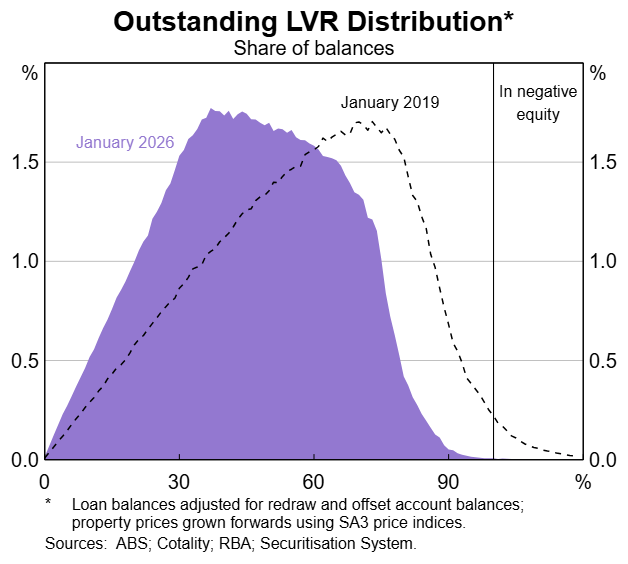
But this is where Australia’s starting position matters enormously, the large increase in housing values preceding the downturn provides an important buffer and for many longstanding homeowners.
The Reserve Bank estimates that fewer than 1 per cent of mortgagors were in negative equity at the beginning of 2026. For many longstanding owners, prices could fall considerably before accumulated equity was exhausted.
The borrowers most exposed are those who purchased recently with high loan to value ratios. For them, relatively modest price declines can technically result in negative equity. But even then, negative equity doesn’t necessarily mean mortgage stress or default.
If a homeowner remains employed, can continue making their repayments and has no need to sell, being temporarily in negative equity can have relatively little practical impact. That is one reason the labour market matters so much for the housing outlook.
The labour market is key
Ultimately, the distinction between an orderly housing correction and something more concerning is likely to depend less on the first few percentage points of price falls and more on what happens to employment.
Higher interest rates are deliberately slowing demand across the economy. The RBA expects economic growth to slow and unemployment to gradually increase. A modest deterioration in the labour market is consistent with an orderly economic adjustment. A much sharper rise in unemployment would change the housing outlook.
Employment income determines households’ capacity to service their mortgages. If unemployment were to rise substantially, forced sales could increase at the same time that buyer demand was already constrained by high interest rates.
That combination would create a much more significant downside risk to prices.
It is therefore unemployment, mortgage arrears and evidence of forced selling, rather than an arbitrary threshold for price declines that are particularly important indicators to watch.
What happens from here?
The next few months should provide more information about how far the current downturn has to run.
Spring usually brings more properties onto the market. The key question this year will be whether buyer demand is sufficient to absorb that additional supply.
If listings rise materially while borrowing capacities remain constrained, buyers will have more choice and vendors will face greater competition, potentially extending the decline.
Another interest rate rise would further reduce borrowing capacities and add to downward pressure.
History offers perspective not a forecast. The current correction has been unusually fast, particularly in Sydney, Melbourne and Brisbane, but it has not yet been unusually deep. However, if recent momentum continued, it could become the largest national downturn in at least four decades.
Despite this, the evidence remains more consistent with an orderly repricing of housing in response to reduced borrowing capacity, taxation changes and weak sentiment, than a crash.
The distinction matters. Home prices can fall further without Australia experiencing a housing crash.
Most borrowers have substantial equity and liquidity buffers, and there is little evidence of widespread forced selling.
The biggest risk would be if today’s conditions were joined by a significant labour market shock.
As long as the labour market remains relatively resilient, home prices can fall further without Australia’s housing correction becoming something more sinister.
Graeme Salt is an award-winning mortgage broker. For a no-obligations consultation please contact him on 02 9922 5055