Lucy Slade Australian Financial Review 28 October 2026
How the new Southwest Metro Sydney train line opening is expected to boost Campsie property values
In Sydney’s south-west, Campsie fruit and vegetable shop manager Bobby Singh is one of many small-business owners looking forward to a boost in foot traffic once the suburb’s new train station opens on Friday, one of 10 new stops on the Southwest Metro line.
“Campsie has got a lot of potential in the coming years because of the train. Hopefully, the real estate market and these things are going to boom,” says Singh, manager at Campsie Super Fresh, a shop in the heart of the suburb’s mall.
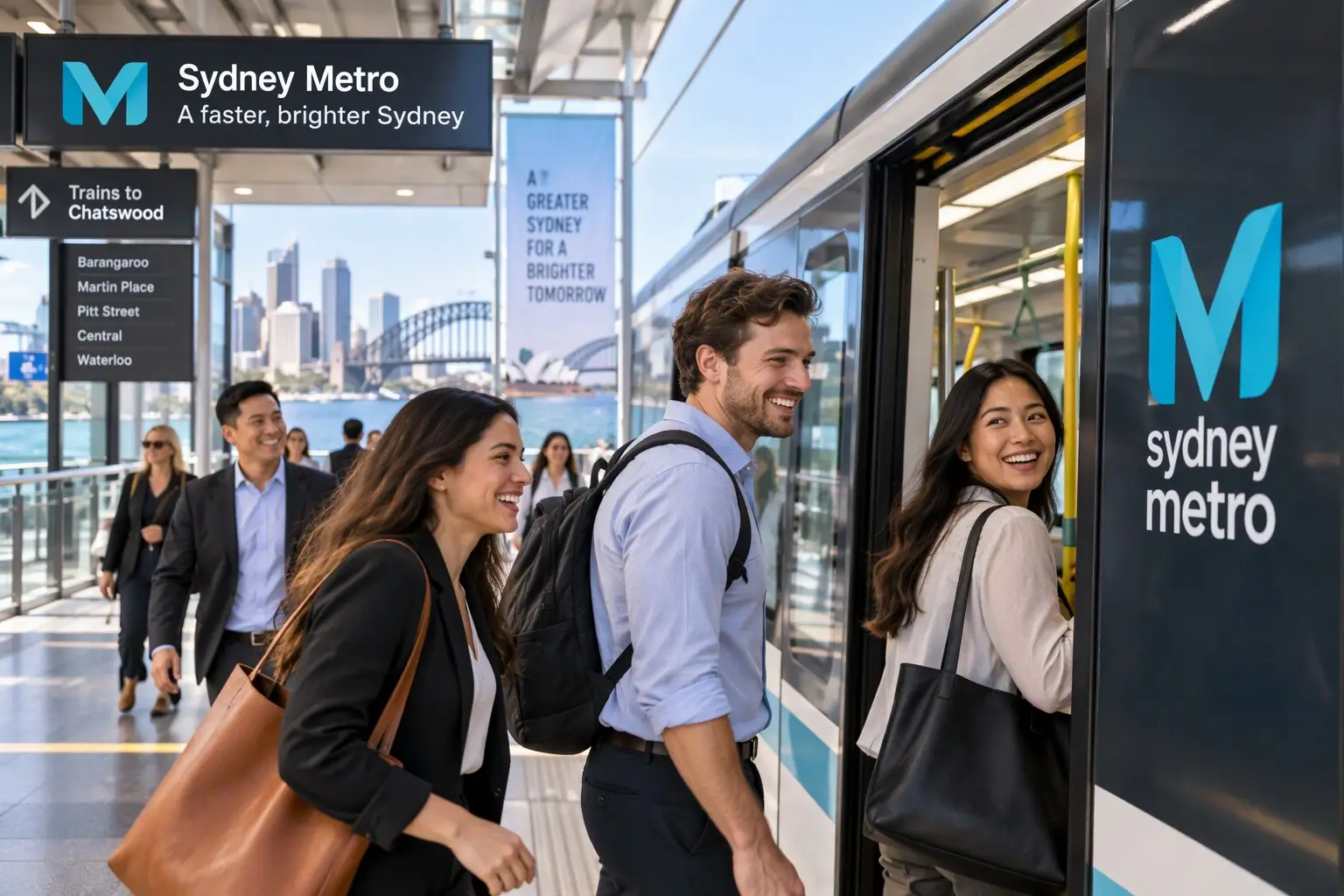
With the opening of the stations between Sydenham and Bankstown, the route’s driverless trains will deliver commuters back and forth to the city significantly faster than by the older electric cable trains they replaced.
Property analysts expect the new Metro line and its speedier commute time will spur a wave of housing development through the south-west corridor, adding desperately needed new homes to Sydney’s stock.
They say new dwellings – primarily apartments – will trickle into the market given the high price of construction and there is plenty of upside potential for house prices in suburbs around the new stations, as a generation of new residents take advantage of the connectivity.
The upgraded stations are expected to be the catalyst for up to 59,500 apartments made possible under the state government’s new planning controls, allowing high rises to be built near transport hubs.
Economists and property market analysts do not expect house prices broadly to start picking up before mid-next year with the prospect of back-to-back interest rate rises back on the agenda as the Reserve Bank of Australia considers how best to tackle stubbornly high inflation.
And yet when the housing downturn is finally over, it is suburbs such as Campsie that will benefit from the new south-west line, according to veteran realtor John McGrath who, along with analysts, nominates the suburb as having the greatest potential for capital growth in the coming years in Sydney.
Popular suburbs around new Southwest Metro stations in the inner west, such as Marrickville and Dulwich Hill, are well into the gentrification process and have median house prices of $2.1 million and $2.3 million, respectively.
A few stops further out on the line and just six minutes from Dulwich Hill on the Metro is Campsie which has a median house price of $1.6 million and unit price of $720,000.
That pricing is in line with the greater Sydney median house price of $1.5 million, but its apartments are valued well below the median unit price of $868,000, according to data provider Cotality.
“We’ve seen Marrickville’s been pretty strong over the last decade and I think you’ll see Campsie going forward will have the same sort of growth,” McGrath said.
“In Campsie, it’s got that nice multicultural feeling about it. It’s got a lot of historical homes but it’s also got some great newer builds and strata units from the ’70s and ’80s. So it’s got a nice mix of overall property and I think it’ll definitely be an outperformer,” he said.
“There are many suburbs in that inner west belt which we’re very bullish on, and that south-west corridor with the new Metro is very good,” he said.
It costs more than $1 million to build a typical mid-rise apartment in Sydney, according to research released by the NSW Productivity and Equality Commission in July.
Cotality’s research director Tim Lawless said that while higher density housing will be facilitated by planning overlays along the Metro line feasibility constraints such as high material, labour and construction costs are likely to keep new unit supply relatively low over the short term.
“However, longer term, we should expect the areas within close proximity to the Metro stations will densify as government policy supports densification along the transport spine and developers take advantage of strong demand to live within an efficient commuting option,” Lawless said.
“Considering the transport upgrade and high level of amenity, Campsie looks like a solid pick for future growth,” he said.
While Sydney’s median has fallen by 7 per cent this year, or just over $100,000, Campsie’s prices have fallen by only 1.7 per cent, as real estate at the top end of the market drops in value much faster than lower-priced homes.
At the end of the upgraded line, Bankstown’s prices have fallen by 1.8 per cent to a median dwelling price of $643,239. Some suburbs on the line are still growing, with Wiley Park ($600,000 dwelling median) up 1.2 per cent.
Ray White economist Atom Go Tian said the downturn is not having much impact on the suburbs with stations further away from the city such as Bankstown, Punchbowl and Wiley Park.
“The line is disproportionately benefiting areas that were otherwise inaccessible. Marrickville already had a train station and it’s quite close to the city so it always had access. Whereas your further areas … you have really cheap suburbs that are now easily accessible to the city,” Tian said.
Over the two years leading up to the opening in 2019 of the first section of the Northwest line from Tallawong to Chatswood, prices in the area grew by 43 per cent, about 10 percentage points higher than greater Sydney’s growth over the same period, according to Tian.
In the two years ahead of the opening of the south-west stations, prices in the area have tracked flat, a reflection of the broader downturn that began at the start of this year. Greater Sydney’s prices have fallen by 2.4 per cent in the same period.
Tian said price growth from new infrastructure projects typically occurs in the two years leading up to the opening in anticipation and in the few years following when people realise the potential.
He expects prices to keep growing near the Western Sydney Airport, which opened on Monday. The connecting Metro line to the airport is due to open in 2027.
Meanwhile, in Campsie, a boost in custom will be very welcome for shop manager Singh who says sales have been down by up to 15 per cent for most business owners since the train station has been closed, as many of the older residents in surrounding suburbs find it too difficult to travel by bus.
About 40,000 daily commuters endured two years on bright pink replacement buses while the old train line was converted into the new transport technology, first developed by Gladys Berejiklian’s Liberal government.
“Campsie has still got an old vibe. I know what they [shoppers] want and how much they can afford,” Singh said.
L’oven Craft Bakery employee Cherie Chai said it has been hard to hire staff as there are not many young people living in the area.
“The business is a bit quiet in the last 18 months. We hope after the Metro opens, it will be getting better and better. I think they [young people] will be coming as it’s convenient,” Chai said.
Towers up to 20 storeys high are now permitted to be built in the multicultural suburb where 35 per cent of residents identify as having Chinese ancestry, followed by Nepalese (9.6 per cent) and Australian (6.2 per cent), 2021 census records show.
NSW planning minister Paul Scully said the Minns government was investing the equivalent of $81 million a day across the state on infrastructure and urban development.
”We’ve unlocked thousands of new homes along the Southwest Metro line so families, young people, downsizers and key workers can live in the communities they choose,” Scully said.